
Last year, more than 13,200 young people in NSW faced homelessness on their own. Without an adult to guide and support them, they have no choice but to navigate a complex service system alone – a system designed primarily for adults and one that is already stretched thin.
Without safety, guidance and the right support services, these vulnerable young people can quickly fall through the gaps and deeper into crisis.
Hundreds of these young people live in Sydney’s Inner West, where Youth Off The Streets operates the Inner West Youth Homelessness Service (IWYHS). Established as part of the NSW Government’s Going Home Staying Home reform over a decade ago, the service supports more than 230 young people each year in partnership with Wesley Mission and YWCA NSW.
IWYHS operates two crisis houses and 12 transitional properties around the Inner West. Young people can stay in transitional accommodation for up to 18 months, giving them the time and stability needed to work towards long-term housing and independence.
Covering a large and diverse geographical area, the IWYHS team is always on the move, whether they’re meeting with young people, coordinating care or collaborating with stakeholders.
On the ground with IWYHS youth workers
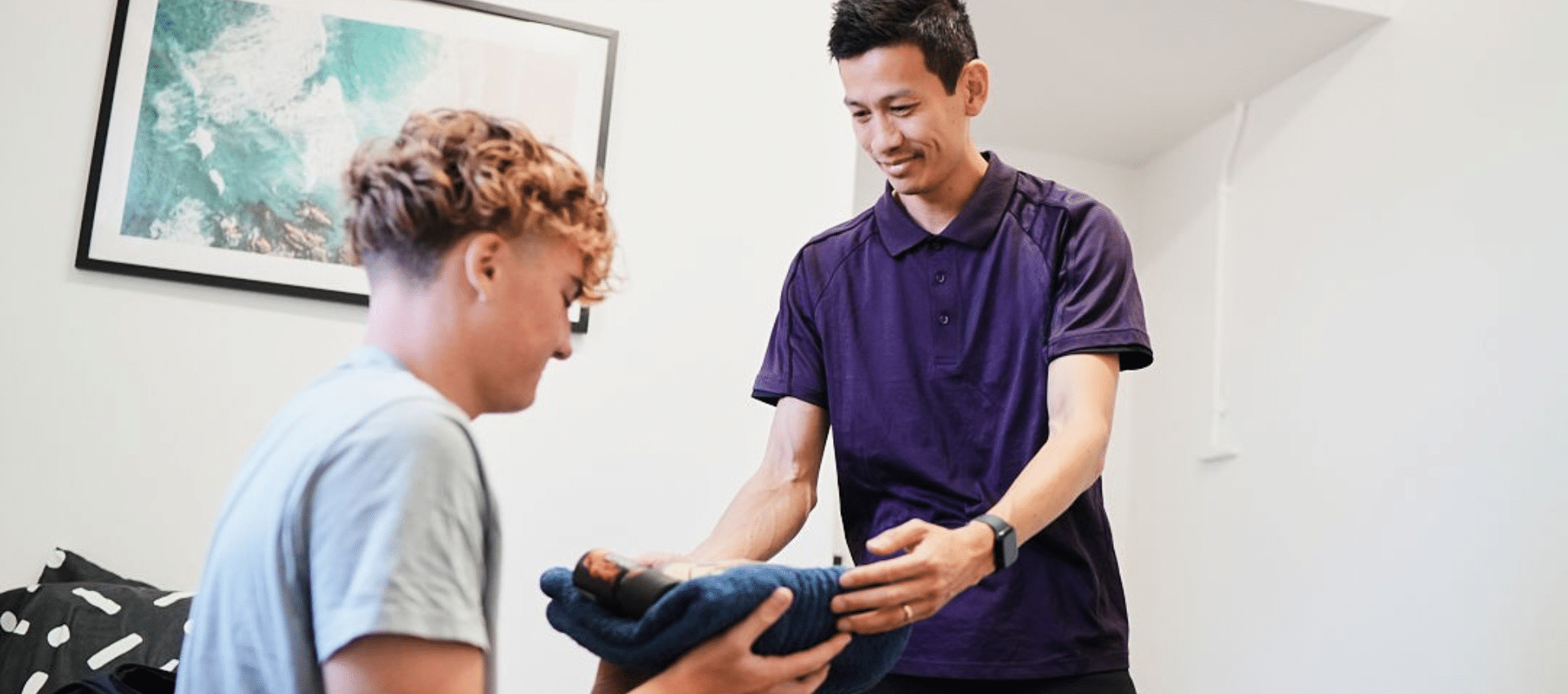
Youth workers support young people with their daily routines, emotional regulation and development of life skills.
“Sometimes our spaces are pretty much that – spaces where we’re supporting young people to learn how to cope,” says Connie Azzone, IWYHS Team Leader Casework. “A young person at one of our houses, Jacob*, cooked his first meal the other day – it took two hours, but it was a success.”
Jacob’s story is one of many. He came to IWYHS with a complex background and undiagnosed neurodiversity.
“A ten-minute conversation for someone else is about forty minutes with Jacob,” says Connie.
The team has adapted their approach to meet the needs of young people like Jacob, who often need tailored support to gain the skills necessary for more independent living.
Youth workers don’t just support young people directly, but make sure that the environment they’re in is safe, functional and conducive to healing.
To create spaces that feel welcoming and secure, IWYHS moved away from the juvenile justice-based approach that many crisis accommodation environments are modelled on.
“As a Therapeutic Crisis Intervention (TCI) facilitator, the therapeutic space meant that we were getting rid of the locks and the permission needed to enter different spaces,” says Joseph Ratuvou, IWYHS Team Leader Crisis Accommodation. “That is not the space that we’re trying to create for our young people.”
For young people, these changes to the physical environment have meant a greater overall sense of agency.

Our IWYHS team supports young people across the Inner West experiencing homelessness.
How our caseworkers provide youth homelessness support
“Without our caseworkers, we wouldn’t be able to do much more than what happens inside the four walls of our crisis accommodation,” says Joseph.
When a young person first reaches out, they go through an intake process and are allocated a caseworker. From there, the caseworker helps identify some of their goals.
While housing is often the top priority, other supports young people cite needing include financial assistance, mental health referrals, education and employment.
ABC News: One in two young people seeking emergency shelter had applications turned down
Caseworkers don’t just coordinate services – they show up in practical ways.
“Another important support is brokerage support for a young person if they need to move out. For example, when they move out of our transitional accommodation into independent living,” says Connie. “We’ll support them with tenancy matters and purchasing a bed, a fridge, a washing machine – whatever it is that they need.”
“That means our caseworkers are sometimes also removalists,” continues Connie. “They’re building flat pack furniture, they’re helping them sign up to utility bills – anything you can think of that we do at home, that’s what our caseworkers do for young people.”
Caseworkers also conduct risk assessments and coordinate with other services to create moments of joy for young people.
The work is demanding, but the impact is real. Behind every success story is a team of youth workers and caseworkers who show up every day with compassion and commitment.
Flexibility in care
At IWYHS, flexibility is essential. One major challenge the team faces is the lack of available beds in temporary accommodation. To preserve continuity of care, stays in crisis accommodation are sometimes extended beyond three months to four or five months.
“Creating instability is something that we don’t want to do,” says Joseph. “When a young person has come from sleeping on the street, carrying deep distrust of authority figures and is maybe expressing that through destructive behaviour, three months often isn’t enough time to build trust and achieve meaningful change.”
The team constantly weigh up whether a young person is ready to move on or whether extending their stay will help stabilise them. Even after they leave, caseworkers continue to provide youth homelessness support, ensuring that the relationship and care doesn’t end when the bed does.
ABC News: Homelessness affects young people’s health, safety, education. Here is Hailey’s story
Navigating the gaps
IWYHS operates in a system full of service gaps, which the team feels daily. The lack of affordable housing is one of the biggest barriers.
“Think of a 16-year-old trying to access that space – there is nothing,” says Joseph.
IWYHS supports young people to budget and manage tenancies, but rigid systems make this difficult. The eligibility criteria for temporary accommodation is inflexible and the process itself can be exhausting.
“We could be down [at the housing department] at 8 am and still not have an answer by 4:30 pm,” Connie says. “When the answer is no, we’re left scrambling to find a safe place for that young person to sleep.”
The complexity of young people’s needs adds another layer. Many are still living in unsafe environments, and the IWYHS team supports them while they’re still experiencing violence or instability.
This kind of work takes a toll and can lead to ‘advocacy fatigue’ and burnout. There’s also the emotional challenge of knowing when to step back.
“You can’t always be holding their hand or pushing them across that line,” says Joseph. “At the end of the day, it’s up to the young person to learn the skills to be able to manage and self-regulate without you. That’s a big focus of our work.”
These challenges are part of daily life at IWYHS. But through it all, the team continues to show up and advocate, driven by the belief that every young person deserves safety, dignity and the opportunity to thrive.
*Name changed to protect the privacy of the young person.