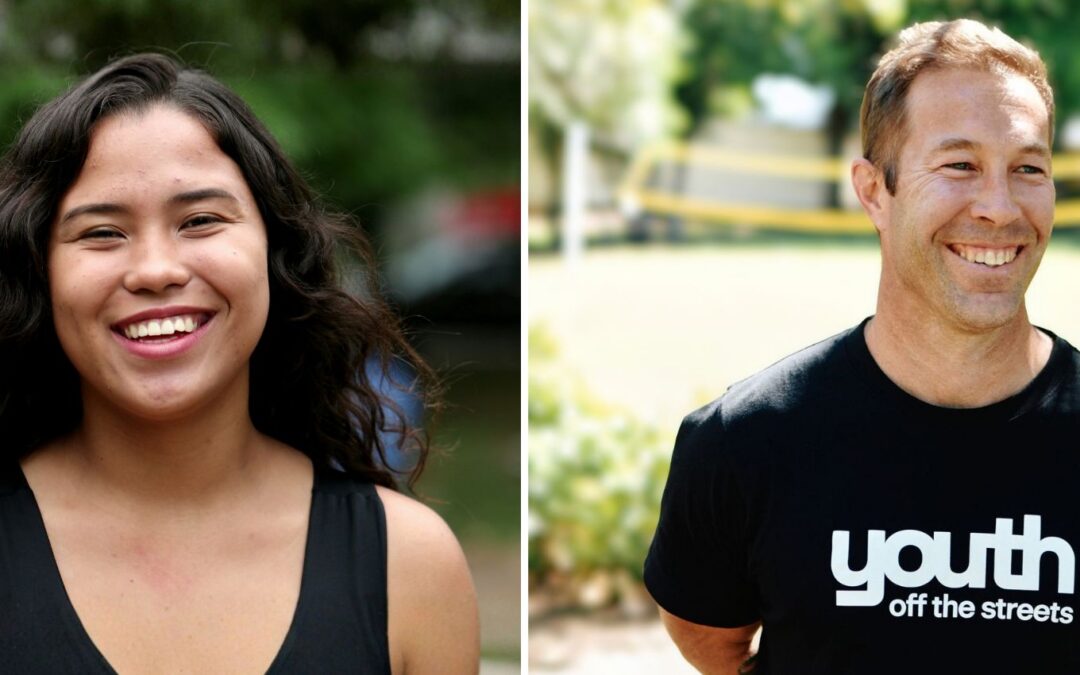
“Experiencing homelessness is extremely traumatic for a young person, regardless of how long they are homeless for,” says Michelle Ackerman, Head of Youth Support Services at Youth Off The Streets. “The main reasons for homelessness for young people are domestic and family violence and family breakdown, so these young people have already experienced significant trauma in their family environment.”
In 2024–25, around half of the young people who presented alone to crisis accommodation services experienced alcohol or drug misuse, a mental health challenge, or both. Only 28.2 per cent of young people aged 12–24 presenting alone to crisis accommodation were enrolled in education, compared to 67 per cent of the general youth population. The unemployment rate among these young people was 84 per cent, compared to 10 per cent of the general youth population.
These are not isolated vulnerabilities; they reinforce and compound one another. Experiencing homelessness at this formative stage of life has lasting consequences. When a young person experiences homelessness, they are far more likely to experience repeated or chronic homelessness later in life.
A system built for adults
Despite this, Australia continues to respond to youth homelessness with a system oriented around adult experiences, expectations and capabilities.
“Existing housing models are not age- or developmentally-focused and do not meet the needs of children and young people,” says Michelle.
The housing system assumes a level of independence, emotional regulation and system literacy that many young people simply do not yet have – especially those carrying the trauma of family violence and homelessness.
For young people, this has immediate and practical consequences. They are expected to independently apply for housing, manage complex paperwork, advocate for themselves with multiple government agencies, understand tenancy law, budget on inadequate income support and live alone in environments that can feel isolating or unsafe. These expectations ignore the reality that many young people have never lived independently – or safely – before.
 “Existing housing models are not age- or developmentally-focused and do not meet the needs of children and young people,” says Michelle Ackerman, Youth Off The Streets’ Head of Youth Support Services.
The results are clear: standard crisis responses are failing young people, with only 27 per cent securing pathways into stable housing and 16 per cent moving into employment.
Other sectors – such as mental health, justice and employment – have dedicated youth streams. Housing, by contrast, remains largely adult-centric. This mismatch doesn’t just fail young people – it actively entrenches harm and keeps young people in crisis.
“We’re constantly trapped in crisis response,” says Michelle. “Responding earlier would help prevent crisis presentations altogether and reduce the trauma children and young people experience through their homelessness.”
Domestic and family violence is one of the main pathways into youth homelessness, yet system responses remain largely focused on adult women and their dependent children.
“There is no real investment in or response to young people as survivors of domestic and family violence in their own right,” says Michelle. “We’re lacking primary and early intervention as well as direct therapeutic supports tailored to young people.”
These gaps reveal a housing system that continues to overlook young people’s realities, leaving them without support at a time of extreme vulnerability.
Youth-specific housing delivers better outcomes
Youth housing models – including youth ‘foyers’ – see between 60–94 per cent of young people exit into positive housing outcomes, compared with 27 per cent in specialist homelessness services. Education enrolments and employment rates are also significantly higher in these models than in standard crisis responses.
The evidence is clear: youth housing models work. They support young people to break the cycle of homelessness and re-engage with education and employment, alleviating pressure from social housing and health, welfare and criminal justice systems.
As a youth-focused organisation, we see every day that housing stability for children and young people is only achievable when it is paired with wraparound, developmentally-appropriate support.
Young people experiencing homelessness are rarely dealing with a single issue in isolation. For this reason, we do not treat housing as a standalone intervention. Our wraparound model brings together safe accommodation with integrated supports across education, employment, mental health, case management and living skills – coordinating services around the young person to build stability and independence over time.
Delivering safe housing is a critical first step, but it is not enough on its own. Young people need time, structure and support to recover from trauma, re-engage with education or training and move towards independence.
If Australia is serious about ending youth homelessness, we need a coordinated, systemic shift.
The Federal Government must lead by investing in a standalone National Child and Youth Homelessness and Housing Strategy – one that recognises children and young people as a distinct cohort with distinct needs and responds with a clear continuum of care from prevention to stability.
“This will help ensure that the 43,000 children and young people who experience homelessness each year are given the priority they require,” says Michelle, “and that responses are age- and developmentally-appropriate.”
Federal and State Governments must also jointly invest in youth-specific housing supply while also funding the wraparound supports that make tenancies sustainable.
“There needs to be a double investment,” says Michelle. “We need the infrastructure to increase supply and targeted funding to help young people maintain tenancies and build their education and employment pathways.”
Young people should not be expected to ‘grow into’ adult housing systems. The system must grow to meet them – now.